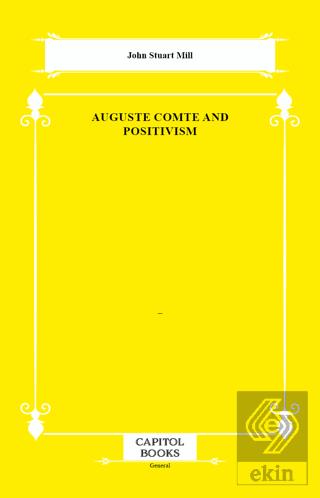
Auguste Comte and Positivism — John Stuart Mill
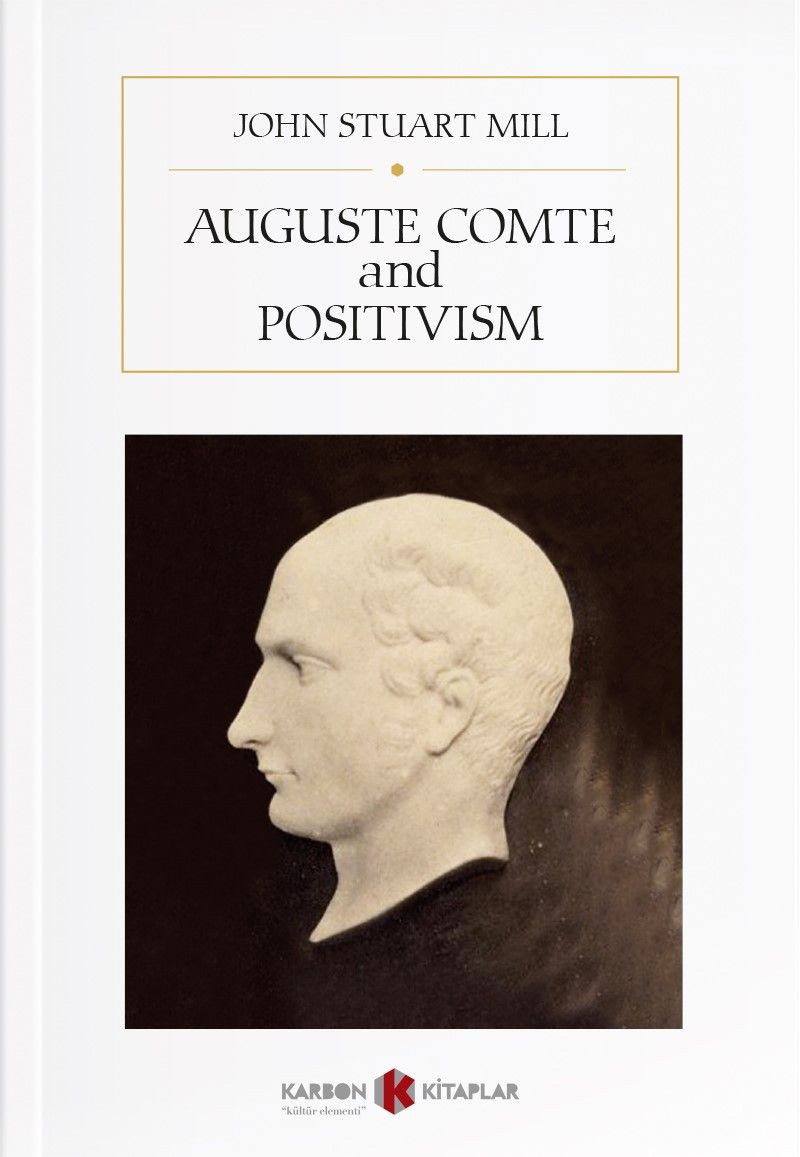
Auguste Comte and Positivism
John Stuart MillKARBON KİTAPLAR
Auguste Comte and Positivism
John Stuart MillThis work discusses the positivist views of the French philosopher and social scientist Auguste Comte Comte is regarded as the founder of positivism the doctrine that all knowledge must derive from sensory experience The two part text was originally printed as two articles in the Westminster Review in 1865 Part 1 offers an analysis of Comte s earlier works on positivism in the natural and social sciences while Part 2 considers its application in areas such as religion and ethics Mill states that Comte is the first philosopher who has attempted to extend positivism to all objects of human knowledge Despite being critical of a number of Comte s views such as the exclusion of psychology from positivist science Mill acknowledges his fellow philosopher s influence in the face of common negative perceptions of the positivist movement
Paper Books
In Auguste Comte and Positivism John Stuart Mill offers a careful incisive examination of the ideas of Auguste Comte the founder of positivism and one of the architects of modern sociology Mill approaches Comte with both admiration and critical distance He recognizes the power of Comte s vision his law of the three stages his ambition to ground society in scientific principles and his effort to create a unified system of knowledge Yet Mill does not hesitate to question what he sees as the authoritarian and quasi religious tendencies within Comte s later thought Balancing respect with philosophical rigor Mill s study becomes more than a commentary on one thinker it evolves into a profound reflection on the limits of science the nature of liberty and the future of modern society A lucid and penetrating dialogue between two giants of nineteenth century thought essential reading for anyone interested in philosophy sociology and the foundations of modern political ideas
Paper Books
In Auguste Comte and Positivism John Stuart Mill offers a careful incisive examination of the ideas of Auguste Comte the founder of positivism and one of the architects of modern sociology Mill approaches Comte with both admiration and critical distance He recognizes the power of Comte s vision his law of the three stages his ambition to ground society in scientific principles and his effort to create a unified system of knowledge Yet Mill does not hesitate to question what he sees as the authoritarian and quasi religious tendencies within Comte s later thought Balancing respect with philosophical rigor Mill s study becomes more than a commentary on one thinker it evolves into a profound reflection on the limits of science the nature of liberty and the future of modern society A lucid and penetrating dialogue between two giants of nineteenth century thought essential reading for anyone interested in philosophy sociology and the foundations of modern political ideas
Paper Books
In Auguste Comte and Positivism John Stuart Mill offers a careful incisive examination of the ideas of Auguste Comte the founder of positivism and one of the architects of modern sociology Mill approaches Comte with both admiration and critical distance He recognizes the power of Comte s vision his law of the three stages his ambition to ground society in scientific principles and his effort to create a unified system of knowledge Yet Mill does not hesitate to question what he sees as the authoritarian and quasi religious tendencies within Comte s later thought Balancing respect with philosophical rigor Mill s study becomes more than a commentary on one thinker it evolves into a profound reflection on the limits of science the nature of liberty and the future of modern society A lucid and penetrating dialogue between two giants of nineteenth century thought essential reading for anyone interested in philosophy sociology and the foundations of modern political ideas Tannıtım Bülteninden
Capitol Books
Capitol Books makes the worlds intellectual heritage accessible to everyone It brings back out of print works from various fields using modern technology and facsimile reproduction methods ensuring each book preserves its originality Capitol Books aims to build a cultural bridge between the past and the present