From Consumer Welfare To Fairness A Functional Framework For Controlling Digital Markets And Beyond Under EU Competition Law — Ahmed Saim Pehlivanlı
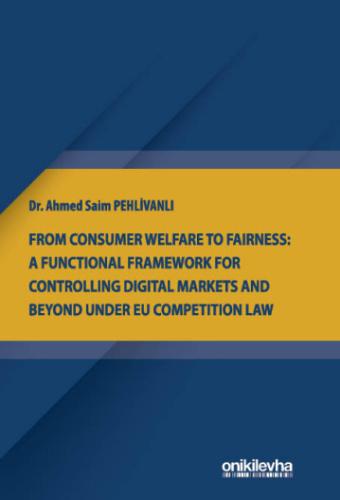
From Consumer Welfare To Fairness A Functional Framework For Controlling Digital Markets And Beyond Under EU Competition Law
Ahmed Saim PehlivanlıOn İki Levha Yayınları
From Consumer Welfare To Fairness A Functional Framework For Controlling Digital Markets And Beyond Under EU Competition Law
Ahmed Saim PehlivanlıDigital markets have exposed a growing tension at the heart of EU competition law For decades the consumer welfare standard has served as its dominant analytical paradigm shaping both doctrine and enforcement practice Yet the rise of data driven platforms zero price services and algorithmic market power has revealed the limits of this paradigm In response fairness has re emerged as an increasingly prominent yet conceptually ambiguous concept in competition law discourse Against this backdrop this book offers a systematic and original rethinking of the relationship between consumer welfare and fairness Rather than treating fairness as a competing objective or a vague normative aspiration it develops a functional perspective in which fairness operates as an analytical tool embedded within Article 102 of the Treaty on the Functioning of the European Union rather than as an autonomous regulatory goal Combining doctrinal analysis comparative insights and empirical text mining of enforcement practice the study demonstrates that fairness has already been implicitly present in EU competition law discourse Building on this finding it proposes a structured framework comprising a proportionality based fairness test a behaviour catalogue and a single gateway rule to reconcile ex ante regulation under the Digital Markets Act with ex post competition enforcement By bridging theoretical debates empirical evidence and practical enforcement design this work provides a coherent implementable and forward looking model for addressing the challenges posed by digital platforms ARKA KAPAKTAN
On İki Levha Yayınları
Digital markets have exposed a growing tension at the heart of EU competition law For decades the consumer welfare standard has served as its dominant analytical paradigm shaping both doctrine and enforcement practice Yet the rise of data driven platforms zero price services and algorithmic market power has revealed the limits of this paradigm In response fairness has re emerged as an increasingly prominent yet conceptually ambiguous concept in competition law discourse Against this backdrop this book offers a systematic and original rethinking of the relationship between consumer welfare and fairness Rather than treating fairness as a competing objective or a vague normative aspiration it develops a functional perspective in which fairness operates as an analytical tool embedded within Article 102 of the Treaty on the Functioning of the European Union rather than as an autonomous regulatory goal Combining doctrinal analysis comparative insights and empirical text mining of enforcement practice the study demonstrates that fairness has already been implicitly present in EU competition law discourse Building on this finding it proposes a structured framework comprising a proportionality based fairness test a behaviour catalogue and a single gateway rule to reconcile ex ante regulation under the Digital Markets Act with ex post competition enforcement By bridging theoretical debates empirical evidence and practical enforcement design this work provides a coherent implementable and forward looking model for addressing the challenges posed by digital platforms
On İki Levha Yayıncılık
Digital markets have exposed a growing tension at the heart of EU competition law For decades the consumer welfare standard has served as its dominant analytical paradigm shaping both doctrine and enforcement practice Yet the rise of data driven platforms zero price services and algorithmic market power has revealed the limits of this paradigm In response fairness has re emerged as an increasingly prominent yet conceptually ambiguous concept in competition law discourse Against this backdrop this book offers a systematic and original rethinking of the relationship between consumer welfare and fairness Rather than treating fairness as a competing objective or a vague normative aspiration it develops a functional perspective in which fairness operates as an analytical tool embedded within Article 102 of the Treaty on the Functioning of the European Union rather than as an autonomous regulatory goal Combining doctrinal analysis comparative insights and empirical text mining of enforcement practice the study demonstrates that fairness has already been implicitly present in EU competition law discourse Building on this finding it proposes a structured framework comprising a proportionality based fairness test a behaviour catalogue and a single gateway rule to reconcile ex ante regulation under the Digital Markets Act with ex post competition enforcement By bridging theoretical debates empirical evidence and practical enforcement design this work provides a coherent implementable and forward looking model for addressing the challenges posed by digital platforms