Neurologic Emergencies — Başar Cander Lukasz Szarpak
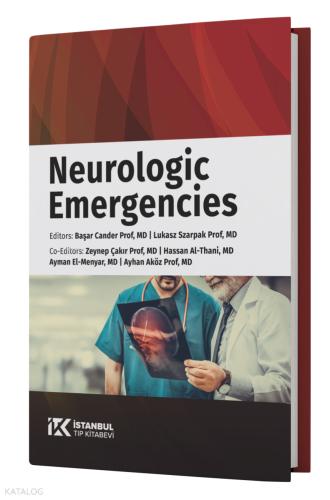
Neurologic Emergencies
Başar Cander Lukasz Szarpakİstanbul Tıp Kitabevi
Neurologic Emergencies
Başar Cander Lukasz SzarpakThe human body possesses an extraordinary creation Every moment of our lives is sustained by millions of reactions occurring within our bodies In the presence of such a magnificent mechanism it is impossible not to feel a sense of admiration Each system and each organ offers life through a harmony that is impossible to fully comprehend Among all these the nervous system stands as the most difficult to understand and remains the most complex system that is still not fully understood Consciousness intellect thought logic and memory constitute an unresolved system that makes the human being human distinguishes humans from other living creatures and in this way makes them subject to accountability Disorders affecting such a system may influence individuals in profoundly different ways Emergency medicine is a unique and exceptionally broad discipline that approaches the human body as a whole integrating deductive and inductive reasoning It has the capacity to involve all bodily systems and addresses all of them simultaneously The core of emergency medicine lies in the care of the critically ill patient within which neurological emergencies occupy a particularly extensive domain For this reason neurological emergencies hold a very broad and equally significant place in emergency medicine education Many neurological emergencies lead to life threatening outcomes and at the same time alter the patient s quality of life They represent one of the most important causes of disability Disability however is not an event that occurs instantaneously but rather a consequential outcome whose effects extend over many years The brain s sensitivity to lack of oxygen particularly in patients with stroke causes medical interventions to become a race against time as expressed by the equation time brain Beyond disorders related to the brain itself pathologies of the peripheral nervous system which is distributed throughout the entire body and constitutes the body s regulatory mechanism may present with a wide range of diverse clinical findings In this academic work which we initiated with the aim of reintroducing our Emergency Medicine textbook to the international community as a foundation we had previously introduced the Resuscitation and Critical Care textbook to our educational community We are now pleased to present our third textbook Neurological Emergencies We are conducting this work with an international team In particular the respected scientist Prof Dr Lukasz Szarpak and his team from Poland have a significant role in this work The respected scientists Dr Hassan Al Thani and Dr Ayman Elmanyar have also provided valuable support for our work I would like to express my special thanks to our valued co editors for their efforts in the preparation of this book firstly Prof Dr Zeynep Çakır with whom we have achieved many accomplishments together I would like to congratulate specialist Dr Ayşe Büşra Özcan a hardworking and successful member of our emergency medicine community for her outstanding work in fulfilling the responsibilities of editorial secretary I further extend my thanks to all members of the EPAT ATUDER Executive Board with whom I have worked closely throughout this journey I would also like to thank İstanbul Tıp Kitapevi an important contributor to medical education and a publisher that has established a special field for Emergency Medicine especially İsmail Şahin Sedanur Akbaş and all their dedicated team members for their efforts Throughout the course of this work I extend my deepest gratitude to my elders and my family as a whole whose support I felt beside me at every moment and to my spouse and children who stood with me day and night without tiring and faced every challenge together with me I remember with respect and mercy my brothers Yener Cander and Mete Cander who preceded us on this path This work is dedicated to my inner world and guide
İstanbul Tıp Kitabevleri
The human body possesses an extraordinary creation Every moment of our lives is sustained by millions of reactions occurring within our bodies In the presence of such a magnificent mechanism it is impossible not to feel a sense of admiration Each system and each organ offers life through a harmony that is impossible to fully comprehend Among all these the nervous system stands as the most difficult to understand and remains the most complex system that is still not fully understood Consciousness intellect thought logic and memory constitute an unresolved system that makes the human being human distinguishes humans from other living creatures and in this way makes them subject to accountability Disorders affecting such a system may influence individuals in profoundly different ways Emergency medicine is a unique and exceptionally broad discipline that approaches the human body as a whole integrating deductive and inductive reasoning It has the capacity to involve all bodily systems and addresses all of them simultaneously The core of emergency medicine lies in the care of the critically ill patient within which neurological emergencies occupy a particularly extensive domain For this reason neurological emergencies hold a very broad and equally significant place in emergency medicine education Many neurological emergencies lead to life threatening outcomes and at the same time alter the patient s quality of life They represent one of the most important causes of disability Disability however is not an event that occurs instantaneously but rather a consequential outcome whose effects extend over many years The brain s sensitivity to lack of oxygen particularly in patients with stroke causes medical interventions to become a race against time as expressed by the equation time brain Beyond disorders related to the brain itself pathologies of the peripheral nervous system which is distributed throughout the entire body and constitutes the body s regulatory mechanism may present with a wide range of diverse clinical findings In this academic work which we initiated with the aim of reintroducing our Emergency Medicine textbook to the international community as a foundation we had previously introduced the Resuscitation and Critical Care textbook to our educational community We are now pleased to present our third textbook Neurological Emergencies We are conducting this work with an international team In particular the respected scientist Prof Dr Lukasz Szarpak and his team from Poland have a significant role in this work The respected scientists Dr Hassan Al Thani and Dr Ayman Elmanyar have also provided valuable support for our work I would like to express my special thanks to our valued co editors for their efforts in the preparation of this book firstly Prof Dr Zeynep Çakır with whom we have achieved many accomplishments together I would like to congratulate specialist Dr Ayşe Büşra Özcan a hardworking and successful member of our emergency medicine community for her outstanding work in fulfilling the responsibilities of editorial secretary I further extend my thanks to all members of the EPAT ATUDER Executive Board with whom I have worked closely throughout this journey I would also like to thank İstanbul Tıp Kitapevi an important contributor to medical education and a publisher that has established a special field for Emergency Medicine especially İsmail Şahin Sedanur Akbaş and all their dedicated team members for their efforts Throughout the course of this work I extend my deepest gratitude to my elders and my family as a whole whose support I felt beside me at every moment and to my spouse and children who stood with me day and night without tiring and faced every challenge together with me I remember with respect and mercy my brothers Yener Cander and Mete Cander who preceded us on this path This work is dedicated to my inner world and guide spiritual guide Ş M A and to the person to whom I owe all the good in my life Başar Cander Prof MD
İstanbul Tıp Kitabevi
The human body possesses an extraordinary creation Every moment of our lives is sustained by millions of reactions occurring within our bodies In the presence of such a magnificent mechanism it is impossible not to feel a sense of admiration Each system and each organ offers life through a harmony that is impossible to fully comprehend Among all these the nervous system stands as the most difficult to understand and remains the most complex system that is still not fully understood Consciousness intellect thought logic and memory constitute an unresolved system that makes the human being human distinguishes humans from other living creatures and in this way makes them subject to accountability Disorders affecting such a system may influence individuals in profoundly different ways Emergency medicine is a unique and exceptionally broad discipline that approaches the human body as a whole integrating deductive and inductive reasoning It has the capacity to involve all bodily systems and addresses all of them simultaneously The core of emergency medicine lies in the care of the critically ill patient within which neurological emergencies occupy a particularly extensive domain For this reason neurological emergencies hold a very broad and equally significant place in emergency medicine education Many neurological emergencies lead to life threatening outcomes and at the same time alter the patient s quality of life They represent one of the most important causes of disability Disability however is not an event that occurs instantaneously but rather a consequential outcome whose effects extend over many years The brain s sensitivity to lack of oxygen particularly in patients with stroke causes medical interventions to become a race against time as expressed by the equation time brain Beyond disorders related to the brain itself pathologies of the peripheral nervous system which is distributed throughout the entire body and constitutes the body s regulatory mechanism may present with a wide range of diverse clinical findings In this academic work which we initiated with the aim of reintroducing our Emergency Medicine textbook to the international community as a foundation we had previously introduced the Resuscitation and Critical Care textbook to our educational community We are now pleased to present our third textbook Neurological Emergencies We are conducting this work with an international team In particular the respected scientist Prof Dr Lukasz Szarpak and his team from Poland have a significant role in this work The respected scientists Dr Hassan Al Thani and Dr Ayman Elmanyar have also provided valuable support for our work I would like to express my special thanks to our valued co editors for their efforts in the preparation of this book firstly Prof Dr Zeynep Çakır with whom we have achieved many accomplishments together I would like to congratulate specialist Dr Ayşe Büşra Özcan a hardworking and successful member of our emergency medicine community for her outstanding work in fulfilling the responsibilities of editorial secretary I further extend my thanks to all members of the EPAT ATUDER Executive Board with whom I have worked closely throughout this journey I would also like to thank İstanbul Tıp Kitapevi an important contributor to medical education and a publisher that has established a special field for Emergency Medicine especially İsmail Şahin Sedanur Akbaş and all their dedicated team members for their efforts Throughout the course of this work I extend my deepest gratitude to my elders and my family as a whole whose support I felt beside me at every moment and to my spouse and children who stood with me day and night without tiring and faced every challenge together with me I remember with respect and mercy my brothers Yener Cander and Mete Cander who preceded us on this path This work is dedicated to my inner world and guide spiritual guide Ş M A and to the person to whom I owe all the good in my life
İstanbul Tıp Kitabevi
The human body possesses an extraordinary creation Every moment of our lives is sustained by millions of reactions occurring within our bodies In the presence of such a magnificent mechanism it is impossible not to feel a sense of admiration Each system and each organ offers life through a harmony that is impossible to fully comprehend Among all these the nervous system stands as the most difficult to understand and remains the most complex system that is still not fully understood Consciousness intellect thought logic and memory constitute an unresolved system that makes the human being human distinguishes humans from other living creatures and in this way makes them subject to accountability Disorders affecting such a system may influence individuals in profoundly different ways Emergency medicine is a unique and exceptionally broad discipline that approaches the human body as a whole integrating deductive and inductive reasoning It has the capacity to involve all bodily systems and addresses all of them simultaneously The core of emergency medicine lies in the care of the critically ill patient within which neurological emergencies occupy a particularly extensive domain For this reason neurological emergencies hold a very broad and equally significant place in emergency medicine education Many neurological emergencies lead to life threatening outcomes and at the same time alter the patient s quality of life They represent one of the most important causes of disability Disability however is not an event that occurs instantaneously but rather a consequential outcome whose effects extend over many years The brain s sensitivity to lack of oxygen particularly in patients with stroke causes medical interventions to become a race against time as expressed by the equation time brain Beyond disorders related to the brain itself pathologies of the peripheral nervous system which is distributed throughout the entire body and constitutes the body s regulatory mechanism may present with a wide range of diverse clinical findings In this academic work which we initiated with the aim of reintroducing our Emergency Medicine textbook to the international community as a foundation we had previously introduced the Resuscitation and Critical Care textbook to our educational community We are now pleased to present our third textbook Neurological Emergencies We are conducting this work with an international team In particular the respected scientist Prof Dr Lukasz Szarpak and his team from Poland have a significant role in this work The respected scientists Dr Hassan Al Thani and Dr Ayman Elmanyar have also provided valuable support for our work I would like to express my special thanks to our valued co editors for their efforts in the preparation of this book firstly Prof Dr Zeynep Çakır with whom we have achieved many accomplishments together I would like to congratulate specialist Dr Ayşe Büşra Özcan a hardworking and successful member of our emergency medicine community for her outstanding work in fulfilling the responsibilities of editorial secretary I further extend my thanks to all members of the EPAT ATUDER Executive Board with whom I have worked closely throughout this journey I would also like to thank İstanbul Tıp Kitapevi an important contributor to medical education and a publisher that has established a special field for Emergency Medicine especially İsmail Şahin Sedanur Akbaş and all their dedicated team members for their efforts Throughout the course of this work I extend my deepest gratitude to my elders and my family as a whole whose support I felt beside me at every moment and to my spouse and children who stood with me day and night without tiring and faced every challenge together with me I remember with respect and mercy my brothers Yener Cander and Mete Cander who preceded us on this path This work is dedicated to my inner world and guide spiritual guide Ş M A and to the person to whom I owe all the good in my life