Polish Consumer Sentiment Indices — Nuray Terzi Sadullah Çelik
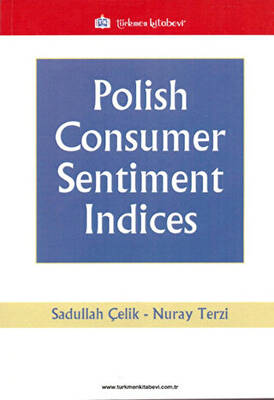
Polish Consumer Sentiment Indices
Nuray Terzi Sadullah ÇelikTürkmen Kitabevi
Polish Consumer Sentiment Indices
Nuray Terzi Sadullah ÇelikEconomics is a social science that tries to understand the fundamentals of human behavior through means of demand supply production consumption profit utility and many other pairs of notations In the meantime economics is at best at its infant stage with so many unknowns that are classified under different jargons like risk and uncertainty depending on the perspective of the economic school of thought that examines the question at hand However the addition of macroeconomics to economics by Keynes and the following economists have been a very difficult task as these researchers were to go into unchartered territories with the area getting larger each time they thought there was a consensus in the profession One important aspect of the economics has always been the expectations of humans However it has been another difficult task to define models for the formation of expectations as well as models to use for extraction of the information from these expectations In this route the leading economic indicators have been very important contributors but also there have been considerable doubters of these indicators as is the case today theless this book considers one of these major leading economic indicators the consumer sentiment for an economy Poland which is arguably the richest one in the world in terms of the number of consumer confidence indices announced every month We examine the relationship between those indices and economic and financial variables in Poland through conventional and rather new and unconventional methodologies Our findings show that some of the indices are superior to others in Poland in terms of causality in both time and frequency domain analysis and the continuous wavelet transforms Hence Polish policy makers should carefully consider which consumer confidence indices they take into account while making important policy decisions for the whole economy
Türkmen Kitabevi
Economics is a social science that tries to understand the fundamentals of human behavior through means of demand supply production consumption profit utility and many other pairs of notations In the meantime economics is at best at its infant stage with so many unknowns that are classified under different jargons like risk and uncertainty depending on the perspective of the economic school of thought that examines the question at hand However the addition of macroeconomics to economics by Keynes and the following economists have been a very difficult task as these researchers were to go into unchartered territories with the area getting larger each time they thought there was a consensus in the profession One important aspect of the economics has always been the expectations of humans However it has been another difficult task to define models for the formation of expectations as well as models to use for extraction of the information from these expectations In this route the leading economic indicators have been very important contributors but also there have been considerable doubters of these indicators as is the case today Nonetheless this book considers one of these major leading economic indicators the consumer sentiment for an economy Poland which is arguably the richest one in the world in terms of the number of consumer confidence indices announced every month We examine the relationship between those indices and economic and financial variables in Poland through conventional and rather new and unconventional methodologies Our findings show that some of the indices are superior to others in Poland in terms of causality in both time and frequency domain analysis and the continuous wavelet transforms Hence Polish policy makers should carefully consider which consumer confidence indices they take into account while making important policy decisions for the whole economy
Türkmen Kitabevi
Economics is a social science that tries to understand the fundamentals of human behavior through means of demand supply production consumption profit utility and many other pairs of notations In the meantime economics is at best at its infant stage with so many unknowns that are classified under different jargons like risk and uncertainty depending on the perspective of the economic school of thought that examines the question at hand However the addition of macroeconomics to economics by Keynes and the following economists have been a very difficult task as these researchers were to go into unchartered territories with the area getting larger each time they thought there was a consensus in the profession One important aspect of the economics has always been the expectations of humans However it has been another difficult task to define models for the formation of expectations as well as models to use for extraction of the information from these expectations In this route the leading economic indicators have been very important contributors but also there have been considerable doubters of these indicators as is the case today Nonetheless this book considers one of these major leading economic indicators the consumer sentiment for an economy Poland which is arguably the richest one in the world in terms of the number of consumer confidence indices announced every month We examine the relationship between those indices and economic and financial variables in Poland through conventional and rather new and unconventional methodologies Our findings show that some of the indices are superior to others in Poland in terms of causality in both time and frequency domain analysis and the continuous wavelet transforms Hence Polish policy makers should carefully consider which consumer confidence indices they take into account while making important policy decisions for the whole economy